For a shopkeeper, the metal shutter is not an accessory: it is the shop's life insurance. It protects the storefront every night, conditions the opening every morning, and the day it jams, turnover stops with it. Yet most shopkeepers inherit their shutter with the lease, without knowing what hangs above their head or how to make it last. This guide fixes that: curtain types, motorisation, 2026 prices, maintenance and obligations — everything a Paris-region shopkeeper should know about their metal shutter.
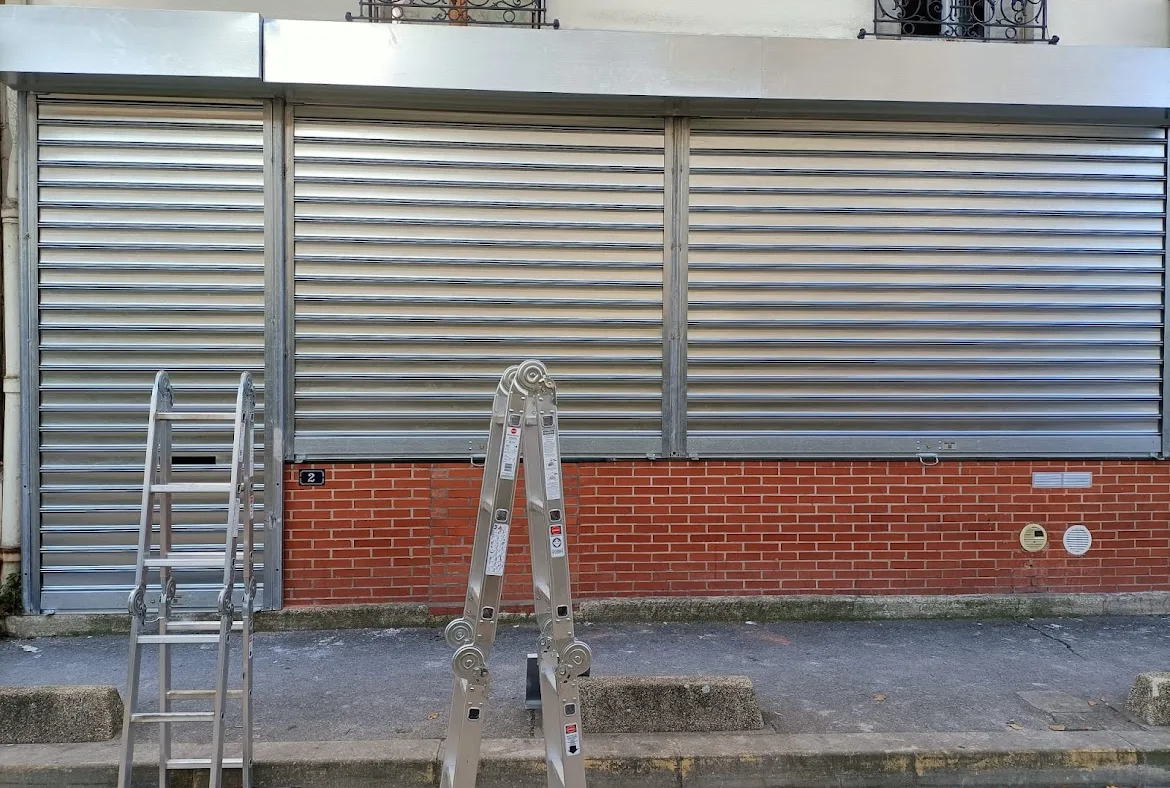
Anatomy of a metal shutter
Four organs to know when talking to your repairer. The curtain: the visible surface of hinged steel or aluminium slats. The axle (or barrel): the horizontal tube in a box above the bay, around which the curtain rolls; it houses the compensation springs that balance the weight — high-tension parts, dangerous to handle untrained. The guide rails: the vertical channels that steer the slats. The drive: manual (direct pull for small shutters, a crank winch beyond) or motorised. When a professional mentions the "bottom slat", that is the reinforced final slat that usually carries the lock; the "clips" are the slat connectors — two classic wear parts.
Which curtain for which business?
The curtain choice trades protection against visibility and budget. Solid slats offer maximum protection and complete opacity: the choice of jewellers, pharmacies and tobacconists — but the storefront disappears at night. Micro-perforated slats keep excellent resistance while letting the lit shop window show through: the favourite compromise of town-centre shops that keep "selling" after closing. Open grilles (wave or tube) provide full ventilation and visibility — car parks, shopping galleries, lobbies — with decent anti-intrusion protection but no privacy. On materials, galvanised steel dominates for robustness; aluminium relieves motors on wide bays. For exceptional widths, made-to-measure design becomes essential — the core specialty of our dedicated site DRM Paris — metal shutter installation and repair, backed by our own workshop where we build axles and curtains.
Manual or motorised: the real calculation
Below 8–10 m² of curtain, manual operation remains defensible: simple, powerless, nearly failure-proof. Beyond, motorisation becomes the rule — and not only for comfort: a heavy curtain hauled by hand wears out its springs and clips prematurely, then the shopkeeper's shoulders. Two motor families: the tubular motor inside the axle for small and medium shutters, and the side motor (chain or direct) for large curtains and intensive use. Always demand a manual override — a crank or release that opens the shutter during a power cut; without it, a blackout on a Saturday morning means a lost day. Add the anti-fall safety brake (mandatory on motorised installations: it blocks the curtain if the axle fails) and, for premises open to the public, compliance with the EN 13241 standard for motorised closures.
2026 prices in the Paris region
Installation: a standard manual shutter fitted starts around €1,500–€2,500; a common motorised model runs €2,500–€5,000; large widths and custom builds go beyond, on survey. Repairs: a simple unjamming starts at €150; a motor replacement costs €400–€900 parts and labour; slats run €50–€120 each; a compensation spring €200–€450. Maintenance: an annual contract with one or two visits costs €150–€400 depending on size — and it is the best-spent money on this page. All prices assume a prior quote; beware, here as in locksmithing, of "€80 unjamming" offers that inflate once the technician is on site.
The maintenance that divides breakdowns by three
A metal shutter performs hundreds of cycles a year, outdoors, in urban dust. Without care, the mechanics degrade silently: springs slacken (the motor compensates, strains, and burns out), rails clog (slats rub, bend, jump out), clips fatigue. The scenario is always the same: months of small ignored signs — a squeal, a hesitant rise, a jolt — then complete failure, on a Saturday at closing time, at night rates. The remedy is one annual visit: rail and axle greasing, spring check and retensioning, motor and limit-switch checks, fastener tightening, safety-brake test. Thirty to forty-five minutes that push back major part replacement by years. For multi-site shopkeepers and chains, contracts with scheduled off-hours visits and repair priority have become the standard.
Jammed shutter: the right moves while you wait
Shutter stuck closed on opening morning: do not insist on the switch — a motor forcing against an obstacle burns out in minutes. Check the breaker and the remote (silly failures exist), look for a slat visibly out of its rail, then call and describe precisely: curtain up or down, motor humming or silent, manual override available or not. Shutter stuck open at night: that is a security emergency — your storefront faces the night unprotected; a good repairer prioritises it and, failing an immediate repair, lowers the curtain manually or secures the storefront provisionally. In both cases, a well-equipped professional resolves most blockages in a single visit — the point of choosing a specialist with real stock and a workshop.
Regulations and the lease question
Three obligations frame your shutter. The EN 13241 standard for motorised closures (anti-fall device, crush protection): an old motorised shutter never brought into compliance engages your liability towards staff and customers. Documented maintenance for premises open to the public: a maintenance contract with reports is your proof of diligence. Planning rules: in town centres and protected areas, replacing a street-visible shutter may require a prior declaration at the town hall, especially if the appearance changes — some municipalities even impose open grilles on ground-floor shops. As for who pays, landlord or tenant: in principle, structural repairs (full replacement, axle) fall to the landlord and routine upkeep to the tenant — but most commercial leases adjust this, within the limits set by French law, which forbids shifting major structural repairs to the tenant. Read your lease's repairs clause before committing to big expenses, and keep the maintenance history: it settles disputes.
What to remember
Choose the curtain for your business (solid for maximum protection, micro-perforated to keep selling at night, grille for ventilation), motorise beyond 10 m² with an override and a safety brake, budget the annual maintenance rather than the emergency call-out, and keep a specialist's 24/7 number saved — shutters rarely fail during office hours. Across the Paris region, our AMG teams handle installation, repair and maintenance with our own axle and curtain workshop — and our dedicated site depannagerideauxmetalliques.fr goes deeper on every topic for shopkeepers.
Need a locksmith right now?
An on-call locksmith answers 24/7 — price quoted on the phone, firm written quote before any work. English spoken.
📞 Call 07 66 54 96 41