The Paris region concentrates a large share of French burglaries every year — density, urban anonymity and escape routes make it prime territory. But behind the anxious statistic lies a more useful truth: the vast majority of burglaries are opportunistic, committed in minutes by visitors who pick the easiest target on the street or in the building. Protecting your home therefore does not mean making it impregnable — nothing is — but making it less attractive than the neighbour's: longer, louder, riskier. Here is how, in order of real-world effectiveness.
How do they actually get in?
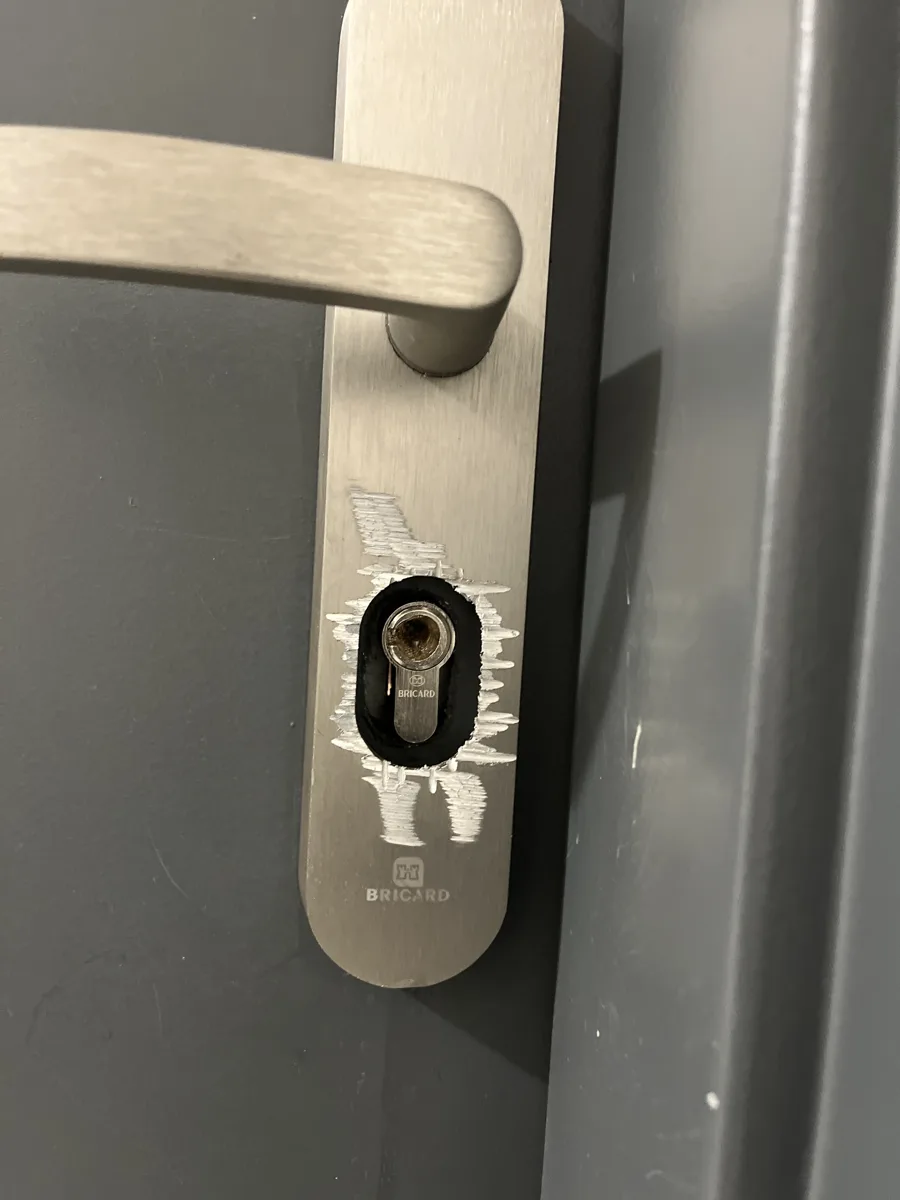
French interior-ministry and insurer studies converge: in flats, the overwhelming majority of intrusions come through the landing door — crowbar pressure, snapped or drilled cylinder, sometimes a merely slammed, unlocked door. In houses, the front door remains the main route, closely followed by ground-floor windows and French doors, the service door (often the weakest in the house) and the connected garage. The methods are fast and unsophisticated: brutal prying defeats a low-end cylinder or single-point lock in under a minute. Remember the "three-minute rule": a home that resists beyond that makes most visitors give up — the whole game is holding those minutes.
Priority one: the front door (where every euro counts double)
If your budget is limited, put all of it on the door. Three investment tiers. Tier 1 (€100–350): replace the cylinder with a high-security model — anti-drill, anti-snap, anti-bumping, card-protected keys — and add an armoured cylinder guard: you have just neutralised the fastest attacks. Tier 2 (€350–1,200): move to a multipoint lock, 3 points in a flat, 5 in a house, ideally A2P-certified — crowbar work becomes long and loud. Tier 3 (€1,500–5,000): armouring of the existing door or a certified security door block, for exposed homes, ground floors and high insured values. At every tier, the fitting is worth as much as the hardware: a protruding cylinder, poorly anchored strikes or weak hinges cancel the investment.
Priority two: the secondary routes everyone forgets
The typical suburban house has a decent front door… and a hollow service door closed by a latch, a bay window without locks, a connected garage whose inner door is never locked. Visitors know it. Treat reachable windows (ground floor, accessible balconies) with keyed handles and, better, roller shutters with anti-lift locking — visual and mechanical deterrence at once. Lock the garage-to-house door like an entrance. Equip the cellar door in apartment buildings: cellars are burglars' training ground. And close the behavioural gap: many "no-forced-entry" burglaries start with a key hidden under a flowerpot or a copy never returned — a card-protected cylinder resets that clock to zero.
Deterrence: planting doubt before the attempt
The opportunist picks his target in seconds of observation. Anything suggesting resistance or presence moves him along. Motion-triggered lighting around approaches, remotely controlled shutters simulating presence, a visible alarm (the outdoor siren above all — noise is its real power), even modest camera coverage: each element alone can be bypassed, but their accumulation tells a story — "this will be long and risky here". Conversely, signs of extended absence — an overflowing letterbox, shutters frozen for weeks, public holiday posts on social media — are invitations. For long absences, France's free Opération Tranquillité Vacances (police patrol sign-up at your local station) remains under-used and effective.
Insurance: read the safety clauses before, not after
Your home policy very likely contains protection requirements: a 3-point or A2P lock above a certain insured value, shutters or bars on ground floors, sometimes an alarm. Ignoring them exposes you to reduced compensation on claim day. Read your policy's theft clause — ten minutes — and bring your equipment up to the required level, keeping the installation certificates. After a burglary, the sequence matters: police report, photos, declaration to the insurer within the contractual deadline (usually 2–5 working days), immediate securing of the home — you are actually obliged to limit further damage — and every invoice kept. A serious locksmith provides an itemised invoice and an intervention certificate as a matter of course.
Five costly myths
"Burglaries happen at night": false — most occur in daytime, between 10 a.m. and 6 p.m., when homes are empty. "I have nothing worth stealing": the visitor does not know that before entering, and the damage often costs more than what disappears. "My dog protects the house": deterrence measured in seconds, not minutes — no insurer counts an animal as a protection device. "I live on a high floor, I'm safe": height reduces window risk, not landing-door risk — the main route at any floor. "An alarm is enough": an alarm signals, it does not block; without mechanical resistance, the intruder finishes before anyone reacts. Effective security always adds mechanics (delay), electronics (alert) and behaviour (don't make it easy).
A smart budget: the three-month plan
Month 1 — free moves: lock the door systematically (a slammed but unlocked door opens in seconds), retrieve the hidden spare key, sign up for Tranquillité Vacances before any absence, tighten social-media privacy. Month 2 — the core (€100–500): high-security card cylinder plus armoured guard on the entrance, window locks on reachable openings, detection lighting. Month 3 — consolidation (€400–1,500): certified multipoint lock, anti-lift shutter locking, service door and garage treated. Beyond that, armouring and full alarm systems deserve a personalised diagnosis — which any serious craftsman offers free during an intervention. That is what our AMG teams do across the eight departments of the Paris region, and the shared philosophy of our specialist houses: custom metalwork at Iron Metal, emergency locksmithing at serrurier-locksmith.fr, shop shutters at DRM Paris.
What to remember
You do not protect a home with a gadget but with a logic: know your real entry points (the door first, secondary routes second), stretch break-in time past the fatal three minutes, stack deterrence signals, and align your equipment with your insurance policy. The good news: the essentials cost between €100 and €1,500 — a smartphone's price to secure what matters most. And the best moment to act is neither after the neighbour's burglary nor after your own: it is now, calmly, with a professional who diagnoses before selling.
Need a locksmith right now?
An on-call locksmith answers 24/7 — price quoted on the phone, firm written quote before any work. English spoken.
📞 Call 07 66 54 96 41