Facing a shelf of locks or a locksmith's quote, the same jargon keeps coming back: single-point, multipoint, European cylinder, A2P one to three stars… Discouraging vocabulary for what is, underneath, a simple logic. This guide walks through it step by step: by the end, you will be able to read any lock quote, situate your current equipment, and pick the right level for your door, your neighbourhood and your insurance policy — without paying for useless security or skimping on the security that matters.
Lock anatomy in two minutes
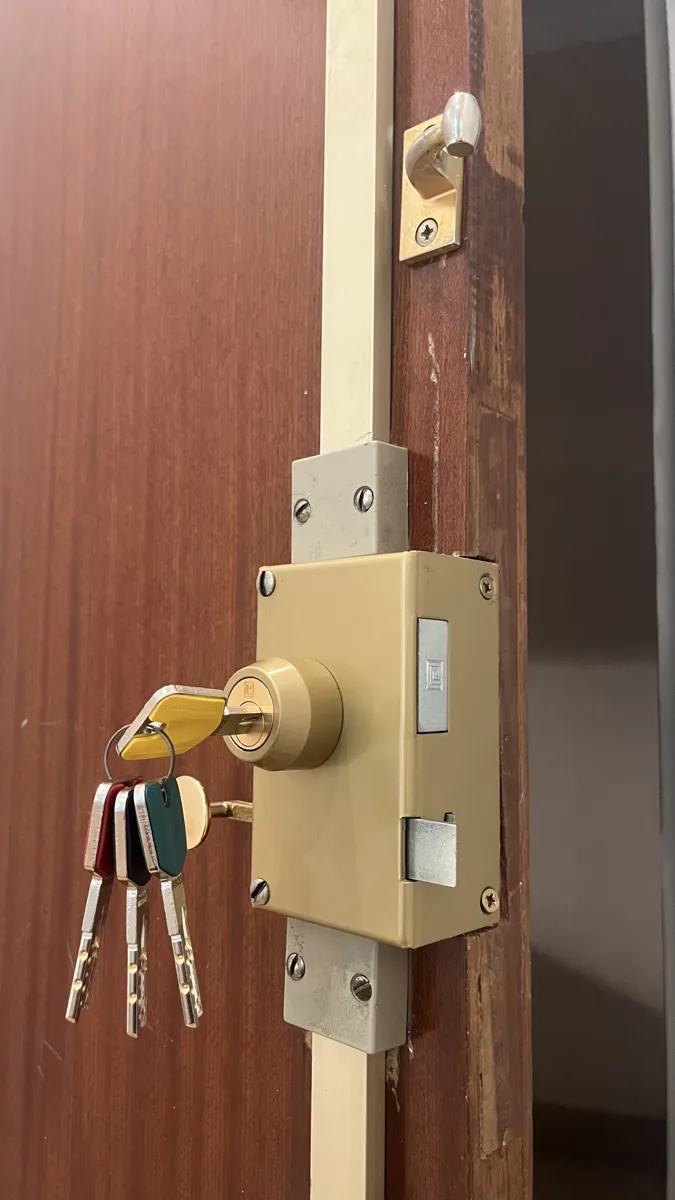
A modern lock has three organs. The cylinder (or barrel): the part the key enters — it decides who can open, and it is target number one for burglars and locksmiths alike. The lock case: the mechanism that turns the key's rotation into bolt movement. The bolts: the steel bars that engage the strike plates fixed to the frame. Remember one golden rule: a door is only as strong as its weakest link. An exceptional cylinder on a worn-out case, or a remarkable lock on a flimsy door, protects no better than the weakest element in the chain.
Single-point or multipoint: the first decision
A single-point lock secures the door in one spot, at mid-height. It is the original equipment of millions of French homes — and burglars' favourite weak spot: one crowbar push at bolt level, or at the top and bottom of a leaf that flexes, and the door gives way in seconds. A multipoint lock engages 3, 5 or 7 points spread over the door's full height with a single turn of the key: the leaf can no longer flex, each point would need to be attacked separately, and the time and noise required exceed what most intruders will risk. For a front door in 2026, the question is no longer "single or multi" but "how many points": 3 points serve a standard upper-floor flat; 5 points are the right call for a house, a tall or exposed door, or a ground floor.
The cylinder: never the place to save money
A market paradox: €12 cylinders and €250 cylinders look identical. The difference is invisible and decisive. An entry-level cylinder opens by bumping (a struck special key — fast and silent), drills in a minute and snaps with pliers. A serious cylinder opposes anti-picking pins, hardened-steel anti-drill inserts, an anti-snap bar — and above all a key protected by a property card: without that card, which only you hold, no duplicate can be cut, even by a professional. No more copies made behind your back by a former tenant or a careless contractor. The price gap between mediocre and excellent is about a hundred euros — over fifteen years of service, the best security investment there is. One detail that is not a detail: the cylinder must never protrude more than 2–3 mm from the door, or it offers a grip for snapping — something every serious fitter checks.
A2P: the only label that means something
"High security", "reinforced", "anti-burglary": marketing phrases that commit no one. The only certification that counts in France is A2P, issued by the CNPP, an independent laboratory that subjects locks to real, tooled break-in attempts. Three levels: A2P★ (5 minutes of certified resistance), A2P★★ (10 minutes), A2P★★★ (15 minutes). Modest-sounding minutes? They are enormous: most burglars give up after a few minutes of loud, fruitless effort. It is also your insurer's reference: many French policies require an A2P lock — often one star for a flat, more for higher insured amounts — and the certificate handed over at installation is your proof in a claim. Check your own door: the A2P logo is engraved on the faceplate, the metal strip visible on the door edge. If it is not there, your lock is probably not certified.
Special cases that change the choice
You are a tenant: you may replace the cylinder at your own expense (keep the original to refit when you leave), but heavier changes — multipoint upgrade, armouring — need the owner's written consent. You live in a condominium: the outside appearance of landing doors is often regulated; a surface-mounted multipoint fitted on the inside face, invisible from the landing, elegantly bypasses the constraint. Your door is glazed: a thumb-turn cylinder is convenient… unless the glazing is within reach of the lock — an intruder who breaks the pane would just turn the knob; in that case, choose a double-entry cylinder and keep a key accessible for emergency evacuation. Your door is weak (hollow-core, warped leaf): do not invest in an exceptional lock — treat the door first, with armouring or a security door block; an honest craftsman will say so before selling you anything.
The five mistakes that ruin a good purchase
Mistake 1: an exceptional lock on a weak door — the intruder does not defeat the lock, he goes through the door; global diagnosis first. Mistake 2: a protruding cylinder — even high-end, 3 mm of overhang invites pliers; demand the measurement at installation. Mistake 3: skipping the escutcheon — the armoured cylinder guard costs €90–180 fitted and neutralises the fastest attack there is; the best value accessory on the market. Mistake 4: unprotected keys — without a property card, anyone who held your keys for five minutes may own a copy. Mistake 5: sloppy fitting — misaligned strikes and binding linkage turn a "security lock" into a temperamental one that fails within two years. Golden rule: buy the fitting as much as the lock.
Smart locks?
Badges, codes, smartphones: smart locks are appealing, and for access management — rentals, cleaners, children — the convenience is real. But keep the hierarchy straight: physical resistance remains mechanical business. A consumer smart lock mounted on a mediocre cylinder opens to a crowbar exactly as before. The sound configuration combines both: a certified mechanical base (A2P cylinder, multipoint), a connected layer for convenience. And if your budget allows only one, choose the mechanics — a burglar does not hack your lock, he forces it.
Which setup for which profile?
Upper-floor flat in a secure building: 3-point multipoint plus an emergency-function, card-protected cylinder — the ideal balance. Ground-floor or top-floor flat: 3 or 5 points certified A2P★, armoured cylinder guard. Detached house: 5 points A2P★ minimum on the entrance, without forgetting the service door and bay windows — the real weak spots of suburban homes. Business premises: certification level per your insurer's demands, a keyed-alike or master-key plan if several staff, and metal shutters for the storefront. After a burglary: replace one level up — refitting the same equipment invites a second visit. In every case, the fitting is worth as much as the lock: aligned strikes, flush cylinder, careful adjustment. And a yearly minute of dry lubricant (graphite or PTFE — never cooking oil, which gums the pins) keeps it all running for fifteen years.
Need a locksmith right now?
An on-call locksmith answers 24/7 — price quoted on the phone, firm written quote before any work. English spoken.
📞 Call 07 66 54 96 41