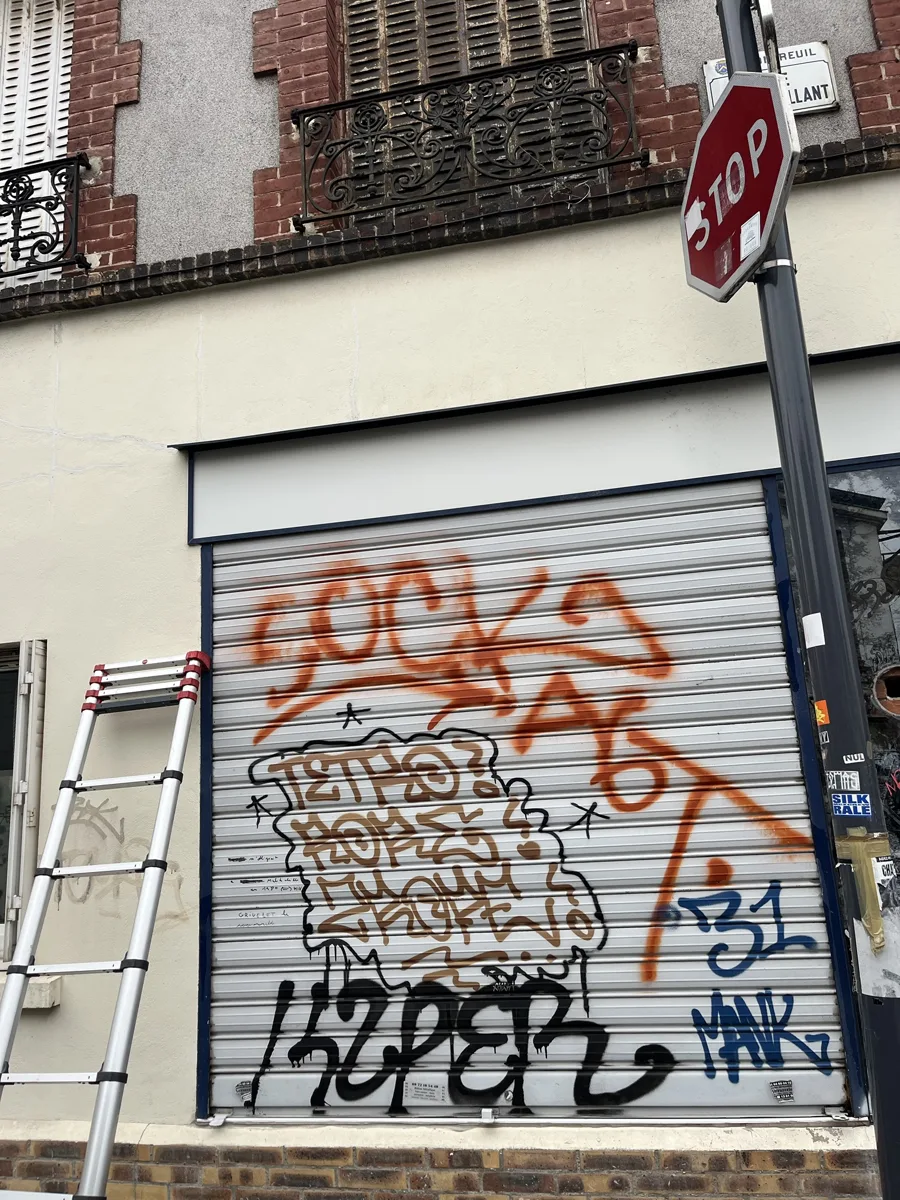
It happens to almost every town-centre shop: one morning the metal shutter is covered in tags. Beyond the degraded image, the practical question comes fast: clean, repaint, or replace the curtain altogether? We refurbish tagged shutters every week across Île-de-France — here is the method we apply, with our own site photos, and the budgets for each option.
Option 1: cleaning — for galvanised or recently lacquered curtains
On bare galvanised slats or factory lacquer in good condition, a professional graffiti remover followed by a low-pressure rinse lifts most aerosol paints without attacking the finish. Allow one to two hours for a standard storefront. The limits: "special" marker inks that migrate into the lacquer, old sun-baked tags, and rusty slats where stripper accelerates corrosion. One tip: act within the week. The longer a tag stays, the deeper it sets — and the more others it attracts.
Option 2: repainting — the best value over time
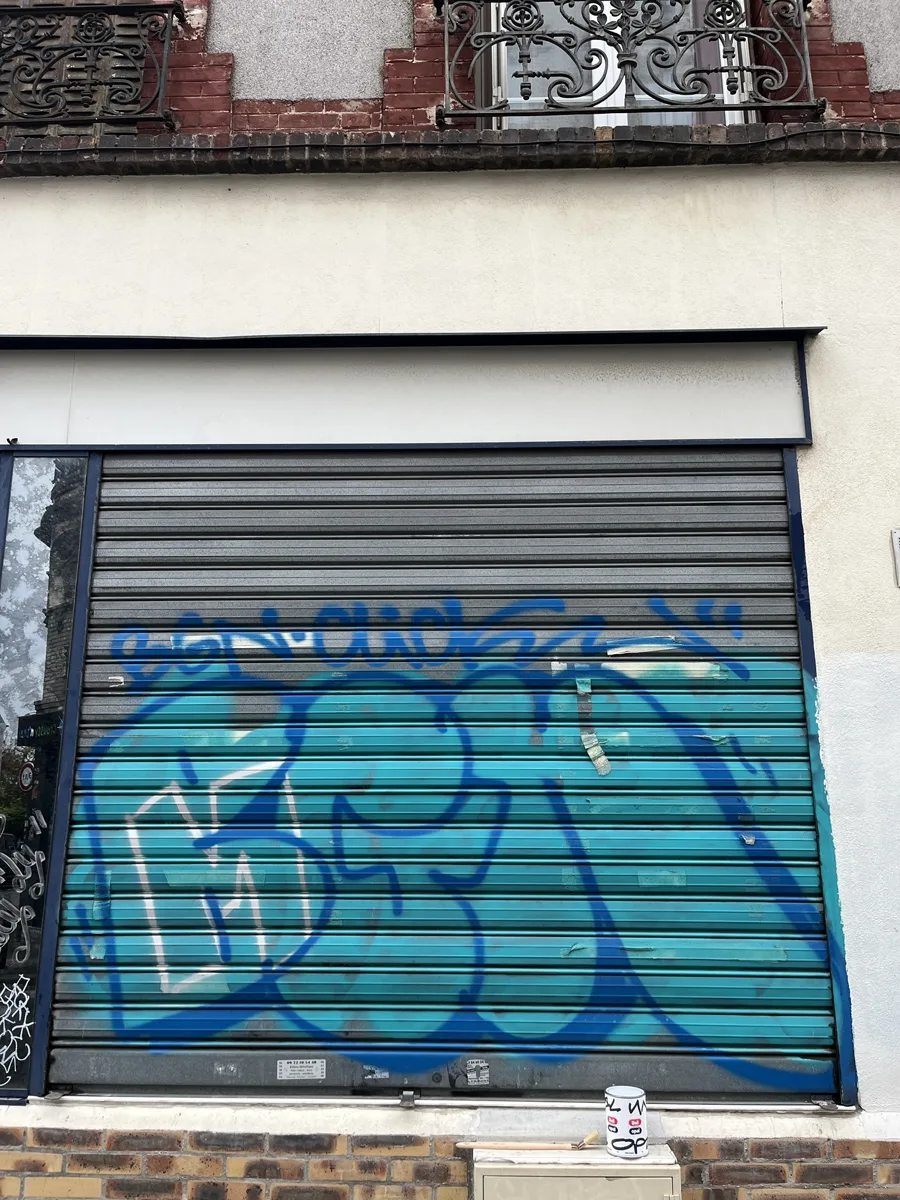
When the shutter has been tagged repeatedly or the original lacquer is tired, a full repaint is almost always the right call. Our process: degrease, light sanding, rust treatment, metal primer, then two coats of polyurethane lacquer — ideally a dark shade, less tempting for taggers than a light curtain. For exposed shops, an anti-graffiti coating lets you sponge off any repeat offence. Budget: a few hundred euros for a standard storefront — five to ten times less than a new curtain. That is the job in our photos: the tagged grey shutter leaves with a uniform finish in half a day.
Option 3: replacement — when tags hide a mechanical problem
A shutter worth repainting must be a shutter that works. If slats are bent from a break-in attempt, if the curtain jumps its guides, if the axle grinds or the motor struggles, tags are only the visible part of the problem. Replacing the curtain alone (keeping sound axle and guides) or the whole motorised shutter costs more, but resets the clock for fifteen or twenty years — and since this autumn's demonstration damage, many insurers treat it as a condition of cover for ground-floor shops. Our metal shutter page details the options; the quote is free, with both routes priced side by side.
Preventing the next tag
Three measures genuinely reduce tagging. Anti-graffiti varnish, which stops paint bonding and washes off with hot water — worth it from the second offence. Lighting the storefront: a curtain in the dark is an offered canvas; a simple sensor light changes the equation. And speed of removal: a shutter cleaned within 48 hours is statistically far less re-tagged than one where the tag "holds". Many Île-de-France town halls also run free graffiti-removal schemes for street-facing surfaces — ask; for anything beyond cleaning, we take over.
Tags and insurance
Vandalism is covered by most commercial policies, but almost always with an excess above the cost of a simple clean — the cover becomes worthwhile for a full repaint or a replacement after heavy damage. The procedure is the usual one: dated photos, police report, declaration within 5 working days, itemised quote attached. And if the tag comes with a break-in attempt — bent slats, forced ground lock — declare both: the burglary section, often better covered, then applies.
The takeaway
One tag on a sound shutter: quick clean, within the week. Repeated tags or tired lacquer: full repaint with anti-graffiti finish. Damaged slats or a worn mechanism: replacement, motorising while you are at it. Either way, don't let it settle in — a cared-for storefront protects your image by day and your business by night. For a free diagnosis, contact us: we cover all Île-de-France, including emergencies when the shutter no longer closes.
Case study: the storefront in our photos
The job pictured above is typical. A street-front shop in the inner suburbs, ten-year-old galvanised solid-slat shutter, tagged three times in two months after a first graffiti stayed up all summer. The owner had tried consumer-grade remover: patchy result, visible halos, re-tagged three weeks later. Our intervention: sticker and residue removal, full degrease, sanding of the oxidised bottom slats, epoxy primer on the repairs, then two coats of anthracite lacquer. Total time: one morning, shutter back in service at noon, shop open throughout. Three months on, no new tag — the dark shade plus a sensor light fitted the same day did the job. The full cost was about one eighth of a new motorised curtain: the order of magnitude to keep in mind.
FAQ
How much does professional tag removal cost? For a standard storefront, one to two hours of labour plus consumables — often below your insurance excess, which is why treating it fast without a claim usually wins. Can the town hall force me to remove graffiti? Yes, municipal bylaws can require cleaning of street-visible graffiti; conversely many councils offer free removal — ask first. Does anti-graffiti varnish hold on an old shutter? On sound lacquer, yes; on an oxidised curtain, repaint first, varnish as a finish. Can micro-perforated slats be repainted? Spray only, with a fluid lacquer — never a roller, which clogs the perforations. The tag came back on my fresh repaint — now what? With a sacrificial varnish: hot-water clean and local re-application. Without: lacquer touch-up — always keep some of the exact shade.